
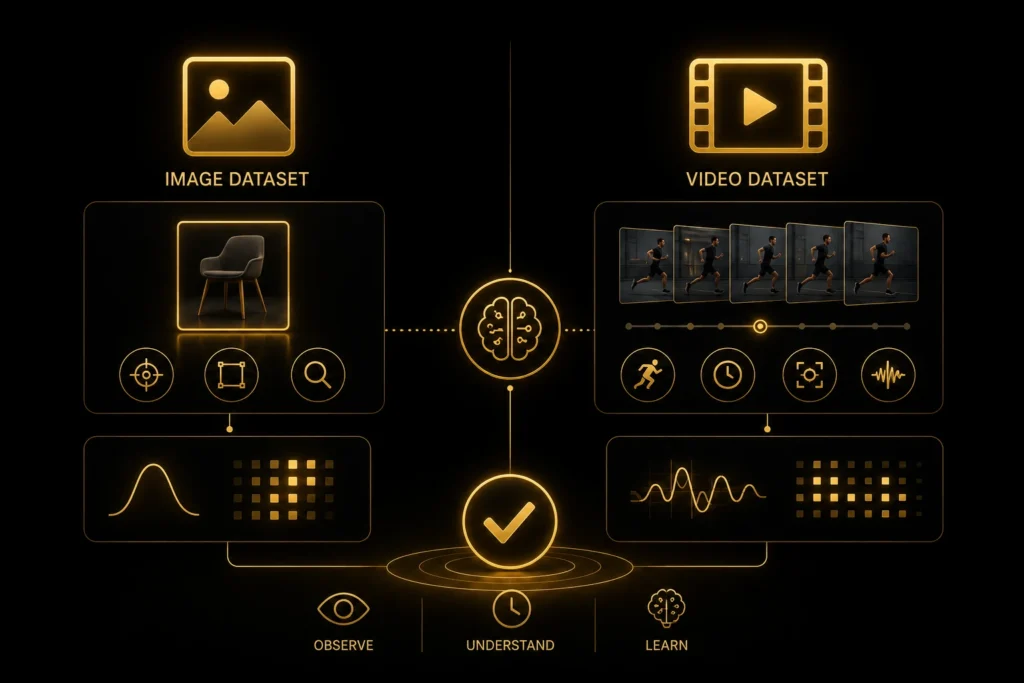
Image and video datasets are both forms of visual training data, but they do not provide the same evidence to a model.
An image dataset for AI training is usually appropriate when the target can be understood from one visual moment: an object, product, pose, document region or static scene. Video datasets for AI training become more important when movement, ordering, duration or state change carries meaning.

The decision should therefore not be based on which modality appears richer. It should be based on what the model needs to observe.
When image datasets are enough
Still images work well for many classification, detection, segmentation and retrieval tasks. If a model only needs to determine that a bicycle is present, where a product is located on a shelf or which class an object belongs to, one visual observation may contain all the necessary information.
Images are also relatively straightforward to inspect and annotate. A bounding box or segmentation mask belongs to one visual state, and the buyer can often assess much of the dataset by sampling individual files. That simplicity is useful, but it also creates an obvious limitation: a still image cannot show what happened immediately before or after the captured moment.
When video provides information images cannot
Video becomes useful when meaning depends on change over time. A still image of a person beside a door may not reveal whether the person is opening it, closing it or simply standing nearby. A short sequence can resolve the ambiguity.
This is why video is common in tracking, action recognition, gesture analysis, event detection, camera-motion understanding, temporal reasoning and video-language applications. The additional information comes with additional design decisions. Buyers need to consider not only file quality but also clip boundaries, event duration, frame sampling and whether the sequence contains enough meaningful temporal variation.
The unit of training changes
With an image dataset, the basic unit is usually straightforward: one image. Video is less obvious. Depending on the task, the useful unit can be a complete clip, a short segment, a sequence of sampled frames or a continuous shot.
That difference matters when comparing vendor statistics. Ten thousand video files can contain dramatically different amounts of training signal depending on clip length, event density and repetition. Similarly, a headline figure of one thousand hours of footage does not tell a buyer how many distinct actions, scenes or useful temporal events are actually present.
Video annotation has a temporal dimension
Image annotation is tied to one visual observation. Video annotation may need to describe both what happens and when it happens.
An action-recognition dataset might attach one label to an entire clip. Temporal localization requires start and end timestamps. Tracking datasets require identity continuity across frames, while video captioning may need descriptions aligned to meaningful temporal segments. For these applications, annotation quality includes temporal consistency as well as label correctness.
Video has a larger redundancy problem
Adjacent frames are often highly correlated. Extracting every frame from a 30 FPS recording can create enormous file counts without creating an equivalent amount of new information.
Sampling strategy therefore matters. Static scenes may tolerate sparse sampling, while rapid actions or subtle motion can require denser observation. When frames are extracted for image-model training, source IDs and timestamps should remain available. Otherwise, near-identical frames from the same recording can easily end up on both sides of a training and evaluation split.
A dedicated human activity recognition dataset is a good example of a use case where temporal evidence, gestures and human-object interactions can make video or sequence-aware data more useful than isolated stills.
Metadata requirements are also different
Image datasets commonly use fields such as subject, category, location, camera information, resolution and scene context. Video may need all of these plus duration, frame rate, timestamps, shot or sequence identifiers and temporal labels.
Good video metadata should make it possible to understand how a derived clip or frame relates to the source. This becomes especially valuable when the same footage is later resampled for a different model architecture.
Which should you buy?
Choose images when one visual instant contains the evidence needed for the target. Choose video when motion, ordering, continuity or duration changes the meaning of the example.
Some projects need both. A multimodal system may use video clips for activity understanding while maintaining extracted stills for spatial annotation or retrieval. There is no requirement that the format purchased from a provider and the final model-input format must be identical. What matters is preserving enough source information to create the representation the model needs.
Frequently asked questions
Are video datasets better than image datasets?
No. They preserve different information. Video is more useful when temporal information matters, while images are often sufficient for static visual tasks.
Can frames extracted from video be used as an image dataset?
Yes, provided the sampling, lineage and split design are appropriate. Highly correlated frames should not automatically be treated as independent examples.
Why are video datasets harder to evaluate?
Video adds temporal factors such as event coverage, clip duration, frame sampling, continuity and sequence-level annotation.
How should I choose between image and video training data?
Ask whether the target label can be determined reliably from one moment. If the label depends on motion, ordering or state change, video is usually the better representation.
Conclusion
The difference between image and video training data is not simply file format. It is the type of evidence preserved. Buy the shortest and simplest representation that still contains the information the model needs.



Pingback: TikTok SEO Guide: Keyword Optimization for Descriptions
Pingback: Best BNWO Captions - Rare Captions
Pingback: JOI Captions That Spark Curiosity and Boost Engagement Fast!! - Rare Captions
Pingback: How AI Hardware and Robotics Are Changing Businesses in 2026 - Rare Captions